In short
- Report it to the police straight away and get a crime reference number.
- Write down every tool, serial number and marking while it’s fresh.
- Tell your insurer the same day and keep all evidence of forced entry.
- Flag the tools as stolen anywhere a buyer or dealer might check.
- Search local resale sites daily for the next two weeks, and never confront a seller yourself.
You open the back of the van and the racking is empty. Drills, impact drivers, batteries, the lot. It’s a sick feeling, and if you work for yourself it’s also a day’s pay, or a week’s, gone in the time it took someone to peel a door.
You’re far from alone. Police forces in Britain recorded 26,724 tool thefts in 2025, about one every 20 minutes, and roughly four in ten were taken from vehicles, according to Freedom of Information data gathered by Direct Line Business.1 Most tools are never seen again: in a 2026 survey for Simply Business, 94% of tradespeople who’d had tools stolen never got them back.2
The first 24 hours are when you can make the biggest difference to those odds, and to your insurance claim. Here’s what to do, in order.
1. Check it’s safe, then leave things as they are
If the thieves might still be nearby, or you see a theft in progress, call 999. Otherwise, before you start tidying up:
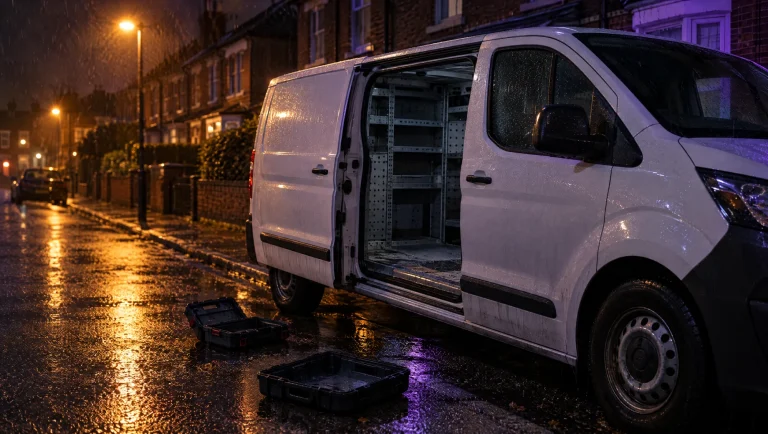
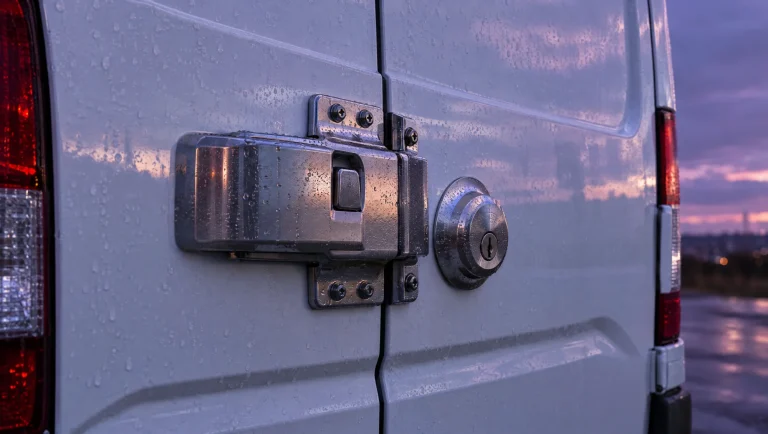
- Photograph the van from every side, including the damaged lock, door or window. Thieves often “peel” the top of a sliding or rear door, or drill the lock barrel.
- Photograph the inside of the load area exactly as you found it.
- Keep the broken lock or anything the thieves left behind. Don’t wipe the door down.
- Ask neighbours and nearby businesses whether they have doorbell or CCTV footage, and note the timeframe the van was left unattended.
Your insurer will usually want proof of forced entry, so these photos matter more than you might think.
2. Report it to the police and get a crime reference number
Report the theft online through your force’s website or by calling 101. You’ll get a crime reference number, which you need for your insurer and for flagging the tools as stolen elsewhere.
Give the police as much detail as you can, and especially the serial numbers. When the Met seized around 400 suspected stolen tools at a car boot sale in Hounslow in December 2025, it appealed for owners to come forward, but only about £6,000 of an estimated £80,000 haul could be returned, because so few people could prove the tools were theirs.3 Police can only reunite you with a tool they can match to you.
3. Make a full list while it’s fresh
Sit down with a coffee and write everything down now, before memory fades. For each item, record:
| Detail | Where to find it |
|---|---|
| Make and model | Your memory, receipts, photos on your phone |
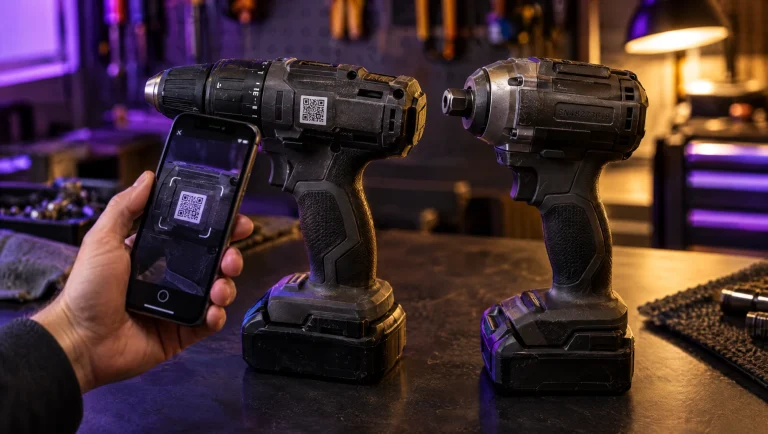
| Serial number | Receipts, warranty registrations, the manufacturer’s app, old photos of the rating plate |
| Batteries and chargers | Batteries have their own serials and are often sold separately |
| Marks and damage | Engraving, paint, stickers, a crack in the case, a repaired cable |
| Value and date bought | Bank statements, merchant accounts, trade counter receipts |
Check your email for online orders and your trade counter account for invoices. Many tool brands also let you register products for warranty, which records the serial number for you.
4. Tell your insurer the same day
Call your insurer or broker as soon as you have the crime reference number. Before you do, read the tools section of your policy, because the small print varies a lot:
- Overnight exclusions. Some policies won’t pay if tools were left in the van overnight, or only pay if the van was in a locked garage.
- Forced entry. Most policies require visible signs of a break-in. Your photos and the damaged lock are your evidence.
- Single-item and total limits. Check the most the policy pays per tool and in total.
Send your list, receipts and photos in one go. A complete claim is a faster claim.
5. Flag the tools as stolen wherever buyers might check
Stolen tools are turned into cash quickly. The more places a serial number shows up as stolen, the harder they are to sell and the more likely a buyer, dealer or officer is to spot them.
If your tools are registered with Regimate, mark them as stolen and add your crime reference number. They’ll then show as stolen in Magic Search to anyone who checks the serial number before buying, and if a dealer, marketplace or insurer checks one through our Finder API, you’ll be alerted straight away. Your name and contact details are never shown.
6. Search the places stolen tools turn up
Stolen tools are often sold within days, frequently close to where they were taken. For the next two weeks, check daily:
- Facebook Marketplace, Gumtree and eBay, filtered to your area. Search by brand and model, and by phrases like “van clear-out” or “job lot”.
- Local car boot sales and markets, especially early on weekend mornings.
- Second-hand shops, pawnbrokers and cash-for-goods stores near you.
It does work. A West Yorkshire gang that stole more than £100,000 of tools from vans was caught after a plumber spotted his own tool bags for sale online.4
Found your tools for sale? Don’t confront the seller. Save the listing, take screenshots, note the seller’s profile and the time, and pass it all to the police with your crime reference number. Never arrange to buy your own tools back or go to the seller’s address alone.
7. Warn your network
Post the list (with photos, but without your home address) in local trade groups, and let your merchants and nearby tool hire shops know. Other tradespeople are often the first to notice a suspiciously cheap set of tools doing the rounds.
8. Get back to work
A theft doesn’t just cost the tools. In a 2025 survey for Markel Direct, a third of victims lost one or two days’ work.5 To limit the damage:
- Hire the essentials for the next few jobs rather than panic-buying everything at full price.
- Ask your insurer whether the policy covers hire costs or loss of earnings.
- Tell customers early if a job will slip. Most people are understanding about a break-in.
As you replace each tool, record its serial number and take a photo the day it arrives. That ten-minute habit is what makes the next theft (we hope there isn’t one) far easier to deal with.
9. Secure the van before tonight
A van with a broken lock is an open invitation to come back for whatever’s left, and thieves do return to vans they know are kitted out. Get the lock repaired or the van parked somewhere secure today, and take everything out overnight until it’s fixed. Our guide to stopping tools being stolen from your van covers the upgrades that make the most difference.
Next time, be ready before it happens
Almost every step above is easier if you’ve done the groundwork: serial numbers recorded, photos taken, tools marked and registered. It takes an evening. Our guide to marking and registering your tools walks you through it, and you can register up to 50 items free with Regimate, with your serial numbers locked to you so nobody else can register them.
Frequently asked questions
Will the police investigate stolen tools?
Every report is recorded and helps police spot patterns, but realistically, charges are rare unless there’s CCTV, a tracker or a recovered item they can link to you. That’s why recording serial numbers and marking your tools matters: it turns a recovered tool into evidence and gets it back to you.
Does my van insurance cover the tools inside it?
Usually not. Standard van insurance covers the vehicle. Tools are normally covered by a separate tools-in-transit or business equipment policy, or an add-on. Check for overnight exclusions and forced-entry conditions.
What if I spot my stolen tools for sale online?
Screenshot the listing and the seller’s profile, then give everything to the police with your crime reference number. Don’t arrange to meet the seller or buy the tools back yourself.
How do I prove stolen tools are mine?
Serial numbers are the strongest proof, backed up by receipts, photos and your own markings such as engraving or UV pen. Registering items in advance, with photos and a proof-of-ownership document, means the evidence is ready when you need it.
Sources
- Direct Line Business, tool theft FOI analysis covering 30 police forces, April 2026. directlinegroup.co.uk
- Simply Business tool theft research (survey of 645 tradespeople), reported March 2026. installeronline.co.uk
- Metropolitan Police, appeal to reunite tradespeople with stolen tools, December 2025. news.met.police.uk
- Yorkshire Evening Post, “drilling gang” jailed over £100k power tool thefts. yorkshireeveningpost.co.uk
- Markel Direct, “Tools Down” research (Censuswide, 500 tradespeople), June 2025. markeluk.com